
 Posts
Posts


Fuck the Dalai Lama
Monday, March 23, 2009
If you took half of all the things the West doesn’t understand about the East and packed them up tightly, you could just about squeeze the resulting mass of misinformation into the Grand Canyon. Brevity precludes me from touching on most of mistaken impressions that cloud Western opinions of Eastern society, but here are just a few notions of which I’ll happi ly disabuse you.
ly disabuse you.1) They’re not really sideways. That revelation disappointed me during a recent six-month sojourn in Changsha, China. Nevertheless, even conventionally oriented oriental gash is a pretty splendid thing.
2) Eastern societies are not “collective,” by contrast to “individualistic” Western societies. If you don’t believe me, try standing in line in Asia. For that matter, try finding a line in which to stand.
3) A fake Rolex is not just as good as a real one. But that wouldn’t stop me from buying a knock-off for twelve bucks in Hong Kong.
4) Most significantly, Tibet was not, NOT, some peaceful mountain Shangri-La prior to the Chinese occupation of 1959. The Dalai Lama is not a saint in exile. Chinese influence in Tibet does not stifle religious expression. Tibetan monks are not freedom fighters and the only legitimate government in Tibet exists through and because of China. The so-called government-in-exile is nothing more than one charlatan and his entourage of kowtowing sycophants eager to maintain the mythology that drives fatuous suburban tits to their doorstep to seek spiritual awakening and leave behind Western cash. It’s a fucking scam, people. He’s a snake oil salesman and his “country” has been part of China since the 13th Century.
So today CNN.com reported that South Africa has refused to grant the Dalai Lama a visa for an upcoming peace summit and it seems some bunch of people are ass-hurt over his being snubbed. Gasp! You mean someone who represents no country, holds no official position in any government anywhere, has never been elected to any office, never attended any academy, never managed any affair and never had a fucking job doesn’t get to go to a shindig for movers and shakers in the get-along-with-others industry? What a travesty. Both Archbishop Desmond Tutu and former South African president F. W. De Klerk announced they’d be sitting out in solidarity with their fellow N
 obel laureate, His Shadiness, the Dalai Lama.
So there are three people evidently not going to a peace summit (whatever that is): a Bantu septuagenarian from the Transvaal, the last white holdout for apartheid, and a slant-eyed prick living large off chicanery in Dharamsala. I sure hope Charlize Theron doesn’t skip out as well. If so, the conference might have to give time, to, I don’t know, maybe influential people actually involved in meaningful fucking peace processes somewhere in the world?! God damn CNN reporting this shit like it’s news. And that’s really the issue.
Nobody needs to care where the Dalai Lama goes or doesn’t go. He’s a trifling, self-promoting stain on the world tapestry. He only matters because Western news outlets seem to think he does and those outlets apparently labor under their mistaken belief because they’re just aching to sustain some wild-eyed idea about an alpine utopia that never existed.
Here are the facts about Tibet. China’s Emperor Kublai Khan installed the first Grand Lama to govern other lamas as a bishop might govern parish priests. The Grand Lama in turn answered to the Emperor and that’s the way things were for Tibet for hundreds of years until another Chinese Emperor first sent an army to support the ambitions of a subsequent Grand Lama who took the title Dalai, meaning Ocean (in a landlocked country a thousand miles from salt water), and assumed for himself the role of ruler of all Tibet. Under the theocracy of the lamas, Tibet boasted such noble traditions as Manorial estates and serfdom, indentured servitude, child rape and slavery.

Until 1959, the Dalai Lama resided in a 1,000-room, 14-story palace overlooking the huddled masses of ignorant peasants that worked the immense lands of various landowners, mostly monasteries. The Drepung monastery, in fact, was once one of the largest landowners in the world with 185 manors, 25,000 serfs, 300 great pastures and 16,000 herdsmen. Secular leaders also made out pretty well, including the commander-in-chief of the Dalai Lama’s army who owned 4,000 square-kilometers of land and 3,500 serfs.
In Tibetan Interviews, Anna Louise Strong recounts her 1959 visit to Tibet during which she witnessed an exhibition of torture instruments used by Tibetan overlords. “There were handcuffs of all sizes, including small ones for children, and instruments for cutting off noses and ears, gouging out eyes, breaking off hands, and hamstringing legs. There were hot brands, whips, and special implements for disemboweling. The exhibition presented photographs and testimonies of victims who had been blinded or crippled or suffered amputations for thievery. There was the shepherd whose master owed him a reimbursement in yuan and wheat but refused to pay. So he took one of the master’s cows; for this he had his hands severed. Another herdsman, who opposed having his wife taken from him by his lord, had his hands broken off. There were pictures of Communist activists with noses and upper lips cut off, and a woman who was raped and then had her nose sliced away.” (www.michaelparenti.org)
And it all might have remained thus in Tibet, despite Mao Zedong’s conquest of the rest of mainland China, except that as with many an accustomed class of fat-cats, the Tibet elite couldn’t leave well enough alone. By the time the People's Army drove the Kuomintang from the mainland, powerful Tibetans had accepted Chinese suzerainty for centuries. In fact, when the current Dalai Lama was installed in Lhasa it was with a coterie of armed Chinese guards and a minister dispatched by General Chiang Kaishek. What concerned Tibetan landlords after Mao’s success in the late 1950s was that their new Chinese rulers were communists. Surely it was only a matter of time before they started extending their egalitarian values to Tibet itself.
And so during 1956-57, armed Tibetan gangs under the direction of powerful landowners began ambushing convoys of the Chinese PLA. Until that time Mao had left Tibet alone for nearly six years. In fact, it is an irony of history that his slowness to act on the Tibet issue stirred much criticism of Mao among Communist Party leaders even within his lifetime. Well, a dictator can only take so much. And after reaching first one
 agreement then another with the Dalai Lama, after the “ruler of all Tibet” proved either unwilling or incapable of abiding by them and after an assemblage of 7,000 wealthy Tibetans met in Lhasa to declare a “free and independent Nation of Tibet” (a ‘nation’ never once recognized as such by any other nation on earth) Mao eventually sent his army to Lhasa and beat the Tibetans like a pack of rented mules. The resistance, if it can be called that, lasted a matter of days.
The Dalai Lama fled in advance of the Chinese. On paper, at least, a condition of his sanctuary in India is that he not engage in political matters. I guess he signed that provision without reading it. He has been behind a campaign of propaganda and revisionist history ever since.
To be sure there have been Chinese excesses in Tibet over the years. During the Cultural Revolution of 1966-1976, it is evident that most Tibetans practiced their religion with caution. It is also true that during the Great Leap Forward, Tibetan farmers suffered from misguided policy, as did peasants throughout all of China. Today, though translated into Tibetan, most textbooks in use in Tibet’s schools focus almost exclusively on Chinese history and culture, a disservice to the nearly six million ethnic Tibetans in the country.
However, of all the putative harm brought in the Chinese wake, a few other changes came to Tibet in 1959, changes about which there can be no debate. The Chinese abolished slavery and the system of unpaid serf labor. They eliminated crushing taxes, implemented public work projects, and practically eliminated unemployment and beggary. They established secular schools, thereby breaking the educational monopoly of the monasteries, and they constructed running water and electrical systems in Lhasa.
“By 1961, Chinese occupation authorities expropriated the landed estates owned by lords and lamas. They distributed many thousands of acres to tenant farmers and landless peasants, reorganizing them into hundreds of communes. Herds once owned by nobility were turned over to collectives of poor shepherds. Improvements were made in the breeding of livestock, and new varieties of vegetables and new strains of wheat and barley were introduced, along with irrigation improvements, all of which reportedly led to an increase in agrarian production.” (Ibid)
Despite these facts, the Dalai Lama promulgates a myth, preying upon Western ignorance and romantic fancy, and the Western press time and time again buys that myth hook, line and sinker. And why wouldn’t we Westerners revel in that myth? We don’t know the first thing about the East, least of all about China, a country whose very emblem is a wall, a wall behind which a society hid for thousands of years, letting in nothing new and letting out nothing but mystery. Chinese metallurgy vastly predates European and yet the former still hasn’t invented the fork!

Chinese writing alone tells a story about the Chinese, not what they write, but how they write it. Several thousand years ago at several places on earth all at roughly the same time, people hit on the idea that using symbols to represent constituent sounds in words, rather than individual words themselves, was a much better idea than drawing stylized pictures of everything. As a result, we have alphabets. English has 26 letters. But while everyone else in the world with a written language came to that conclusion, the Chinese said, “No thanks. We’re good with what we’ve got,” and as a result, they still have literally hundreds of thousands of characters. It’s not very efficient, but then it’s Chinese.
That sort of uniquely Chinese closed-offishness is something that exacerbates Western misconceptions of who and what China is. We can’t understand the Chinese and Chinese custom does very little to help us understand them. We don’t fail to communicate just because our languages get in the way, we fail also because the most fundamental aspects of our cultures grew along divergent paths and under vastly different influences for thousands of years. Of everything foreign to the West, China certainly is the most foreign and as with other foreign things, since we don’t understand China, deep inside we fear it.
That’s a shame in this day and age. China represents many things in this world and the world of the near future, some of them frightening, others completely innocuous. Sadly, however, most of the West seems afraid of exactly the wrong things. We read often in the mainstream press of China’s possible militancy. That’s silly. The Chinese can build all the battleships they want. As long as they’re built to Chinese specifications, half of them will sink at the christening ceremony. We hear quite a bit as well about Chinese computing technology and its possible application to info-terrorism. Take it from me; my 13-year-old niece can outmaneuver any division of Chinese authorities on the internet. And worst, we hear trumped-up tales of Chinese misdoings in poor, little Tibet, flames fanned by the Dalai Lama in his ceaseless quest for living martyrdom. Fuck him. He’s a liar and a would-be despot.
What we need to be worried about vis-à-vis China are things like the unrelenting, toxic grey that chokes much of this earth’s largest land mass as a result of the more than two billion tons of coal burned every year in Chinese power plants, facilities t
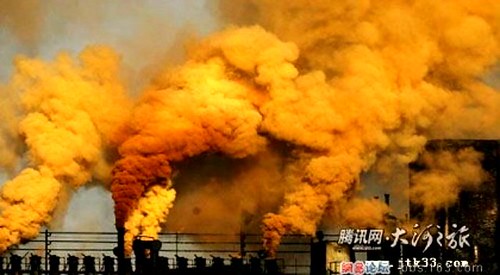 hat lack desulphurization systems. We might also worry about the long-term impact of a coming economic collapse in a country of nearly 1.4 billion people with more than 30 million jobs lost in the past year for migrant laborers alone. The trickle out of what Gordon Chang has called Beijing’s regime of “fakery” is alarming (The Coming Collapse of China). If the world’s fourth largest economy evaporates, well that could be scary.
Then too we might want to worry about this; throughout its history China has experienced a revolution approximately once every 50 years. It has been a little more than 60 years since the end of the Second World War when Mao’s forces engaged Chiang’s in China’s last revolution. The uprising in Tiananmen Square happened in 1989. That was 20 years ago and the government’s response to those student-led protests might have bought China some time. One could maintain credibly that the communist Party has held onto power largely because of reforms introduced following Tiananmen. While the Soviet model fell apart as hard-liners tried to clamp down, the Chinese government softened its stance, eased some restrictions and gave the common Chinese people the chance to go to shopping malls and buy shit they don’t need. Market reforms have allowed the Chinese to let off some steam without granting the people any real relief from centralized authority.
That’s an interesting history lesson. Totalitarianism and capitalism can go quite well together, as long as those in charge recognize something of fundamental importance: people entertained by the opportunity to consume will not demand a hand in their own governance. But the ruse won't last forever. On the ground in China you can feel the pent-up anger. There's something astir among the people and the government will ultimately, one way or another, lose control. They're due for a revolt, overdue in fact. One-fifth of the world's population in civil war - that's a scary prospect, particularly since China's neighbors include North Korea, Myanmar and a newly belligerent Russia.
So yes, there’s much to think about with regard to China and its position in the world today and down the road. But the one thing we hadn’t ought to think about for even a second is the Dalai fucking Lama. It is a disservice to a public who needs to know and foresee to be distracted by some Himalayan huckster purveying a fairy tale. Shame on CNN, shame on other networks of its ilk and shame on all of us who watched all seven agonizing years of Seven Y
 ears in Tibet and believed that anything so cockamamie could possibly be accurate. It’s a fable, a worn-out, useless fable that one could ignore, save for the fact that the Dalai Lama uses his supposed victimhood to draw attention away from something that truly should matter – a peace summit – and onto himself as though he had any ambition worth caring about.
I said it before and I’ll say it one last time; fuck the fucking Dalai fucking Lama.

0 comments:
Post a Comment